
Last updated October 16, 2026
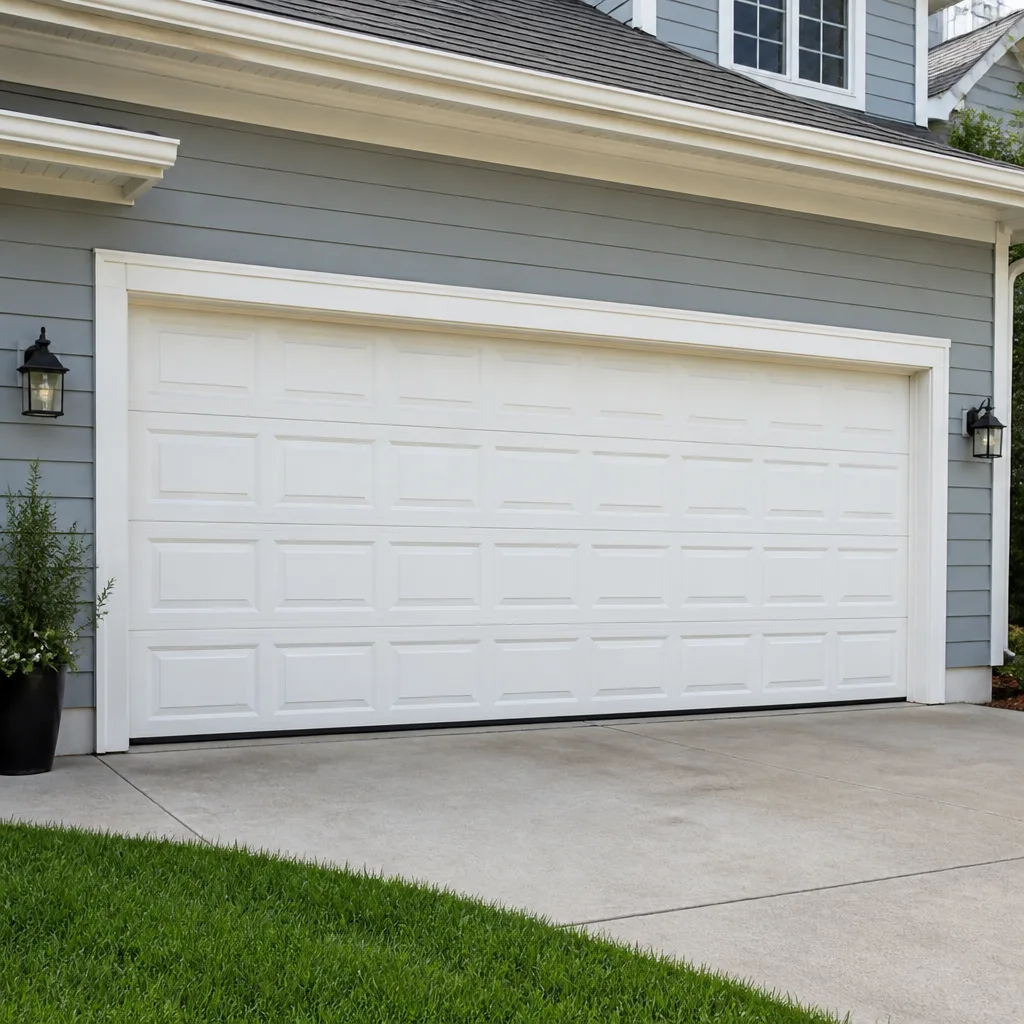 Raised-panel steel
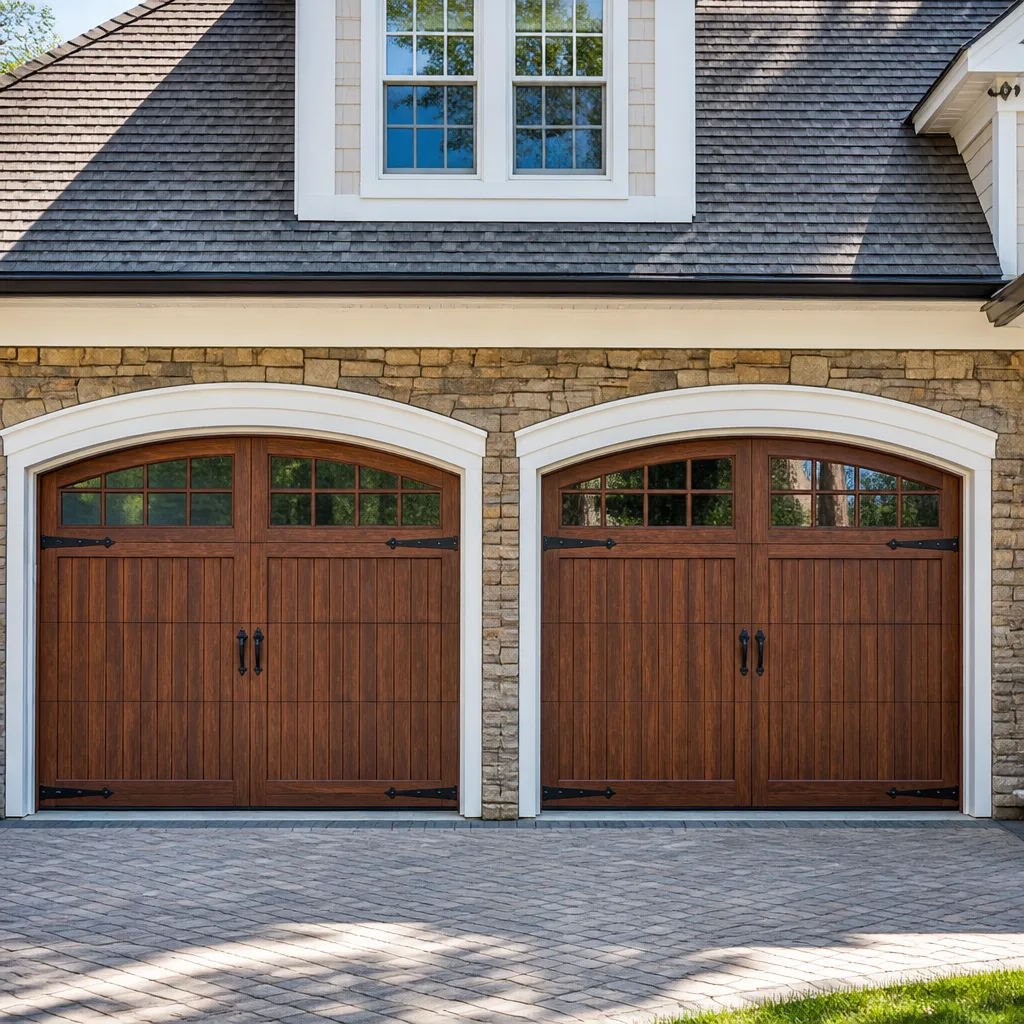 Carriage house
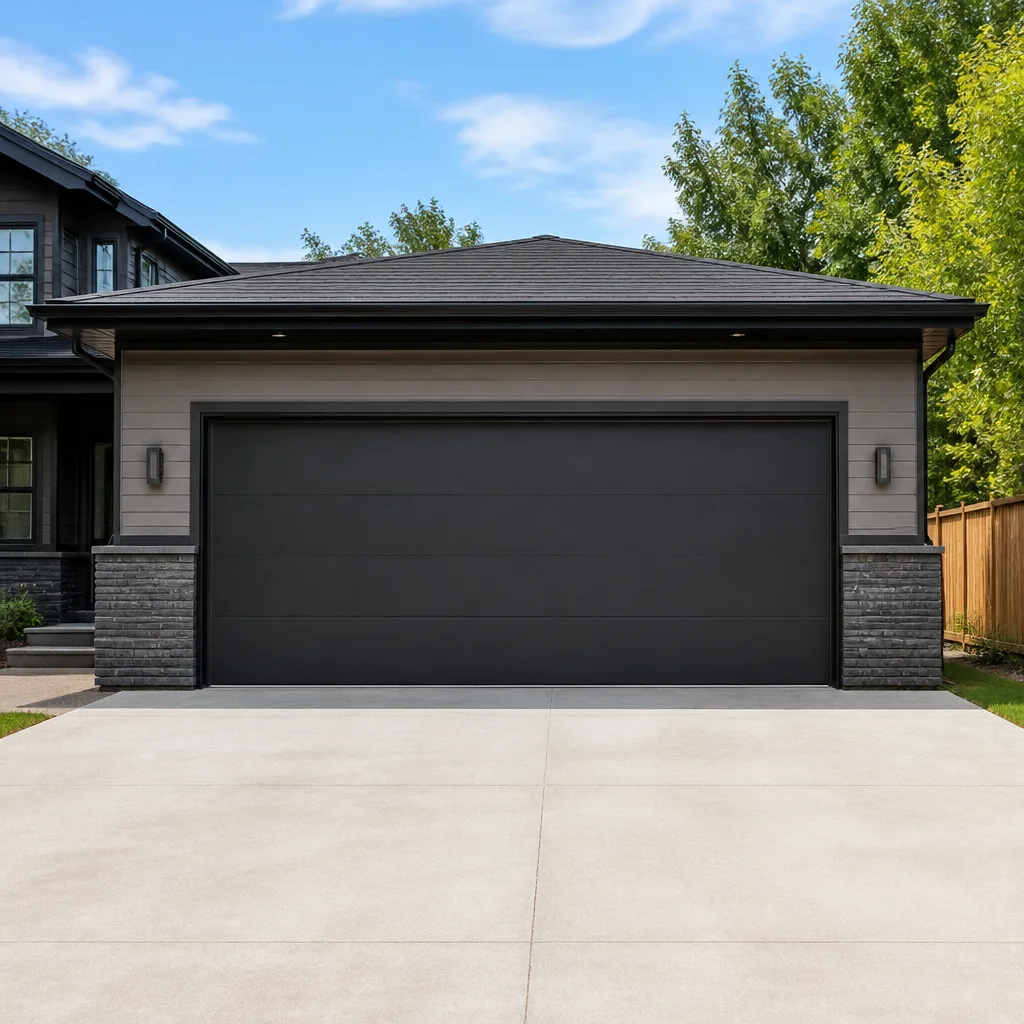 Modern flush
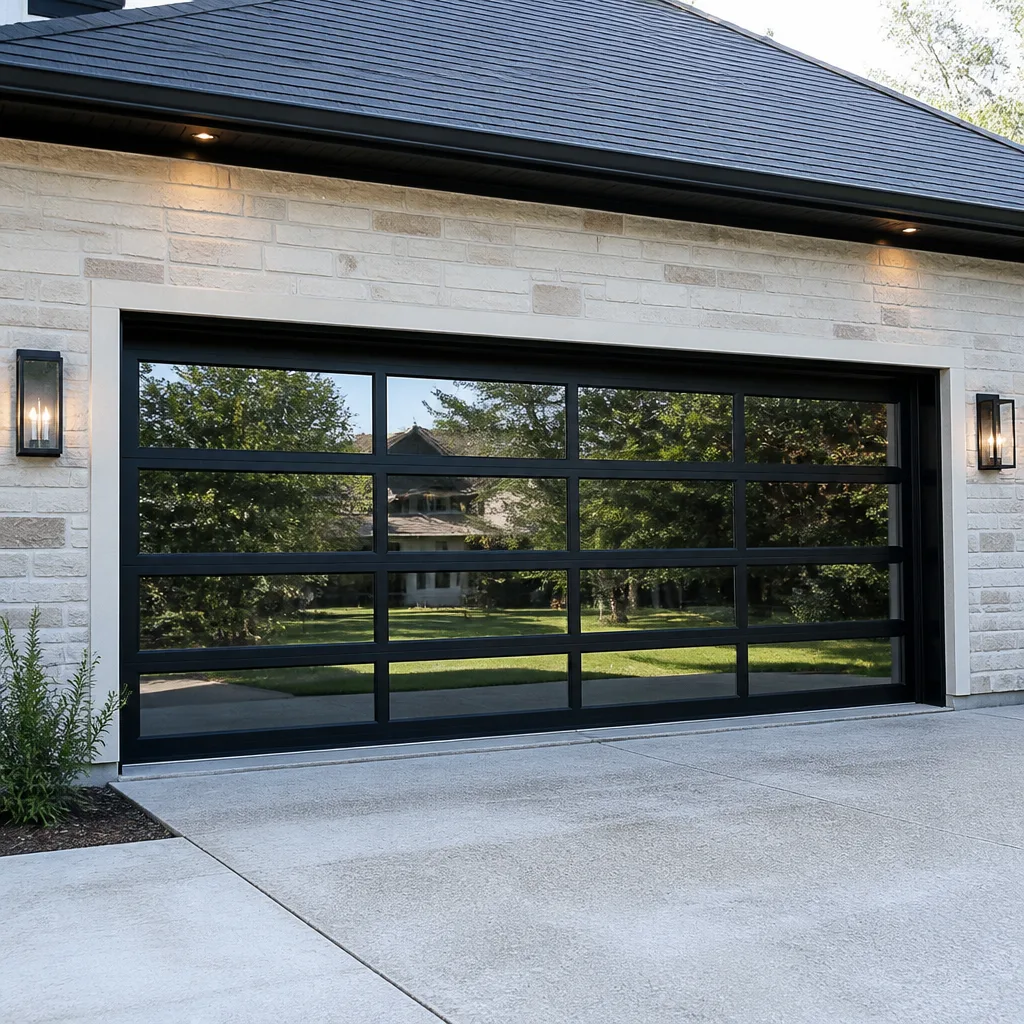 Full-view glass
 LiftMaster openers
 Chamberlain openers
Full 25-point door and opener safety check with every visit - springs, cables, rollers, tracks, and your LiftMaster or Chamberlain opener included
You get a price before we start. It does not change when the truck arrives.
Get your free estimateSeasonal Garage Door Care for Las Vegas: Year-Round Homeowner’s Guide
Most garage door maintenance advice you’ll find online was written for places with rain, snow, and actual seasons. Las Vegas doesn’t work that way. We get roughly 300 days of sunshine, summer attic temperatures that can hit 160°F, and winter cold snaps that drop into the 30s overnight. That combination does specific, predictable things to a garage door system, and the homeowner who understands the local calendar, not a generic one, will spend less on repairs and get more years out of the door. This guide is our year-round map for exactly that, built from two decades of service calls across Las Vegas, from Summerlin to Henderson to Mountains Edge, and you can find more guides & resources on our blog.
Quick Answer
In Las Vegas, garage door maintenance should happen on a two-season rhythm, not a four-season one. The single most important task, lubricating the torsion spring assembly and rollers, is best done in October and again in March, when temperatures are moderate and before the extreme heat or cold stresses metal parts. The second most important task, checking and adjusting the weatherstripping seal, needs attention in May and November, because Las Vegas temperature swings between day and night expand and contract that seal enough to change the gap under your door by up to a quarter inch.
Styles & brands we work with
Table of Contents
- Why Las Vegas Is Different: The Two-Season Reality
- The Las Vegas Month-by-Month Garage Door Calendar
- The Weatherstripping Problem: Why That Gap Keeps Changing
- Sun Damage and the West-Facing Garage Problem
- Dust Storm (Haboob) Cleanup: What Gets In and What It Does
- The Post-Summer September Checklist: Five Things to Check
- What a Clean Job Site Means in a Desert
- How Lubrication Actually Works (And Why It’s Not Optional Here)
Why Las Vegas Is Different: The Two-Season Reality
Las Vegas doesn’t have four seasons in the traditional sense. It has two punishing ones: a brutal summer that runs from late May through September, and a mild-but-windy winter that runs from December through February. Between them sit two short transition periods, October-November and March-April, and those transition windows are when a homeowner should do almost all scheduled garage door maintenance. The reason is simple physics. Extreme heat thins out lubricant and causes metal to expand. Sudden cold makes metal contract and tightens cable tension. Most generic “spring maintenance” advice tells homeowners to lubricate the door in April or May, but by then in Las Vegas the heat is already arriving, and the lubricant you apply in May will be baked thin by July. October, on the other hand, is after the heat peak but before winter contraction tightens cable tension, making it the single best month to lubricate a Las Vegas garage door’s torsion spring assembly.
We’ve serviced doors in every part of the Las Vegas valley, and the pattern is consistent. Homeowners who follow a generic national maintenance schedule are doing their lubrication roughly six months late for our climate. The result is a door that sounds fine in spring, then starts grinding or squealing by August because the lubricant evaporated in June and July. Understanding the two-season reality, and working within it, is the difference between a door that lasts 12 years and one that needs a spring replacement every 4 or 5.
The Las Vegas Month-by-Month Garage Door Calendar
Here’s the schedule we recommend to homeowners across Las Vegas, based on what actually fails, when it fails, and why, as detailed in The Complete Guide to Garage Door in Las Vegas. This is the calendar we’d hand to a homeowner in Summerlin, Centennial Hills, or Green Valley on day one.
- January: Watch for cable slack. Las Vegas cold snaps, when overnight lows dip into the 30s, cause metal to contract. That contraction tightens the lift cables and can throw off the door’s balance. You don’t need to do anything active, but listen for a door that suddenly sounds heavier or strains more on cold mornings. If the opener sounds like it’s working harder on a 38-degree morning than it did in November, call for a balance check.
- February: Test the auto-reverse safety feature. The door should reverse when it meets resistance. This is a year-round safety check, but February is a good anchor month because it’s still cool enough to stand in the garage comfortably. Place a roll of paper towels or a 2×4 flat under the door and close it. If it doesn’t reverse within two seconds of contact, the force setting needs adjustment.
- March: Spring lubrication, round one. Temperatures are mild, usually in the 60s and 70s, which means lubricant goes on evenly and stays where you put it. Lubricate the torsion spring (the heavy coil mounted above the door that handles most of the lifting weight), the rollers, the hinges, and the opener chain or belt rail. This is the last comfortable window before the heat returns.
- April: Inspect the bottom seal while it’s still pliable. The rubber or vinyl strip along the bottom of the door is the front line against dust, insects, and heat intrusion. April is a good time to look for cracks or flat spots before summer temperatures accelerate the aging. If the seal is hard or cracked, replace it now rather than in July when it will be brittle and stubborn to remove.
- May: Weatherstripping adjustment, round one. As daytime highs push into the 90s, the gap between the door and the frame changes. Walk around the door at mid-afternoon and look for visible light coming through the side and top seals. A gap of even a quarter inch lets cool air escape and dust blow in.
- June – August: Do nothing scheduled. This is the survival season. Limit garage door use during the hottest part of the day when possible, because the opener motor works harder against heat-stiffened parts. If you have a west-facing garage (see the section below), the door itself can reach 140°F or more on an August afternoon, which accelerates seal brittleness and shortens lubricant life. Check the door once a month for new squeaks or grinding sounds.
- September: Post-summer inspection. After three months of heat, do the full five-point checklist in the section below. This is the most important inspection of the year, because the door is about to face winter wind with whatever damage summer caused.
- October: Fall lubrication, round two. October is the single best month for this in Las Vegas. The heat has broken, temperatures are in the 70s and 80s, and the lubricant will stay effective through the winter. The torsion spring assembly, rollers, and hinges all benefit. If you only lubricate once a year, do it in October.
- November: Weatherstripping adjustment, round two. As nighttime temperatures drop, the metal track and door panels contract, and the seal that was fine in September may now leave a visible gap. Check the side seals again and adjust the track brackets if needed.
- December: Inspect the cables before winter travel. December is a high-use month for garages: holiday travel, guests, kids home from school. A cable that’s frayed or showing rust is at risk of snapping under the added cycle count. Look at both lift cables (the steel wires running along each side of the door) and look for broken strands or rust discoloration near the bottom bracket.
For a deeper look at garage door repair in the Las Vegas market, including what common repairs cost, see our guide to Garage Door Repair in Las Vegas.
The Weatherstripping Problem: Why That Gap Keeps Changing
The gap between a garage door and its frame, the space the weatherstripping is supposed to seal, expands and contracts enough in Las Vegas temperature swings to require adjustment twice a year. Most homeowners never think about this until they see a scorpion or a mouse in the garage, or notice a dust film on everything stored near the door. But the mechanism is straightforward. The metal track brackets that hold the door against the frame are mounted with bolts. As ambient temperature swings from a 45-degree winter night to a 105-degree summer afternoon, the metal in those brackets, the track itself, and the door panels all expand and contract. A steel door panel can change dimension by a few hundredths of an inch per foot per 100 degrees of temperature change. That doesn’t sound like much, but across a 16-foot door, it adds up to a visible gap.
In Las Vegas, the daily temperature swing alone, often 25 to 30 degrees between pre-dawn and mid-afternoon, causes the gap to change slightly over the course of a single day. The seasonal swing, from winter lows in the 30s to summer highs above 110, causes a much larger change. We’ve measured gaps under Las Vegas garage doors that open up by a quarter inch between March and August, then close back down by November. That’s why we recommend checking and adjusting the weatherstripping in May and November, when the seasonal change is most pronounced and the adjustment will hold for the longest stretch. If you adjust it in July, you’re adjusting for the extreme, and the seal will be too tight when the weather cools and the metal contracts.
There’s a secondary effect worth knowing about. The vinyl or rubber weatherstripping itself expands and contracts with temperature, and Las Vegas UV exposure hardens it over time. A seal that was soft and conforming when installed in spring can become stiff and unyielding by the following winter, which means it no longer fills the gap even if the gap itself hasn’t changed. This is why we tell homeowners to replace the weatherstripping every 2 to 3 years in Las Vegas, not every 5 to 7 years as national guides suggest.
Sun Damage and the West-Facing Garage Problem
If your garage door faces west in Las Vegas, you’re playing on hard mode. Direct afternoon sun in July and August in Las Vegas is not just hot, it’s remarkably destructive to the materials that make up a garage door. The bottom seal, that strip of rubber or vinyl along the bottom edge of the door, is the most vulnerable part. In a west-facing garage in a subdivision like Summerlin or Providence, the bottom seal can sit in direct afternoon sun for four to five hours a day during the summer. Surface temperatures on the door and seal routinely exceed 140°F. Repeated daily exposure to that kind of heat plus intense UV radiation breaks down the polymer chains in the seal material, causing it to become hard, brittle, and cracked.
The replacement interval changes dramatically with sun exposure. On a north-facing or south-facing garage in Las Vegas, a bottom seal might last 3 to 4 years before it needs replacement. On a west-facing garage, we regularly see homeowners needing a new bottom seal every 18 to 24 months. The same acceleration applies to the weatherstripping along the sides and top of the door, though those see less direct sun and tend to fail more from heat than from UV. Genie and Chamberlain openers installed in west-facing garages also run hotter, which shortens the life of the opener’s motor components. If you’re choosing a new door and you have a west-facing garage, consider Clopay or Amarr doors with factory-applied UV-resistant finishes; the manufacturers use different topcoat formulations for sunbelt markets, and it makes a measurable difference in how the door holds its color over a decade.
If you’re in a west-facing garage and you’re not sure whether the door itself is worth saving or replacing, start with a conversation about Garage Door Installation in Las Vegas. An honest assessment costs nothing, and it’s better than throwing parts at a door that’s nearing the end of its useful life.
Dust Storm (Haboob) Cleanup: What Gets In and What It Does
Las Vegas gets dust storms, the big ones called haboobs, most often in late summer, between July and September, when monsoon moisture pushes wind across the dry desert floor. A single haboob can carry fine silt particles 50 miles or more. Some of that dust ends up inside your garage, even with the door closed, because the seal is never perfect and the wind pressure against the door creates a slight negative pressure inside the garage that pulls dust through any gap. But the bigger problem is what the dust does to the door’s moving parts.
Desert dust is not ordinary household dust. It’s fine, abrasive, and often alkaline. When it settles on the torsion spring, the rollers, or the hinges, it mixes with the lubricant and forms a gritty paste. Every time the door opens and closes, that paste grinds against the metal surfaces, accelerating wear. We’ve seen rollers with bearing surfaces scarred by dust-laden lubricant in a single season. The fix is straightforward but often overlooked: after a major dust storm, blow out the track and the torsion spring assembly with compressed air or a leaf blower, then wipe down the rollers and hinges with a dry cloth before re-lubricating. The track itself, the C-shaped metal channel the rollers ride in, is particularly prone to collecting a dust-and-lubricant slurry at the bottom curve, which can make the door run stiff or noisy.
There’s also a less obvious dust-related problem: the safety sensor lenses. The photo-eye sensors mounted on each side of the door, about 6 inches off the ground, are exactly the right height to collect fine dust during a wind event. A thin film of dust on the sensor lens is often enough to break the invisible beam and prevent the door from closing, which is the most common “my door won’t close after a dust storm” call we get. Wiping the sensor lenses with a dry, soft cloth, not a wet one, is the fix in most cases.
The Post-Summer September Checklist: Five Things to Check
September is the most important inspection month of the year for a Las Vegas garage door. The door has just survived three to four months of extreme heat, and it’s about to face winter wind and whatever damage summer caused. Here are the five things to check, in order of importance. Each of these takes less than five minutes except the balance test.
- Check the balance. Pull the emergency release cord (usually a red handle hanging from the opener rail) and manually lift the door halfway. A properly balanced door will stay in place at the halfway point. If it drops, the torsion spring is losing tension and the door is working too hard, which shortens opener life and increases the risk of a spring failure. If it rises on its own, the spring is over-tensioned, which is also a problem. Most torsion-spring replacements in Las Vegas run $150 – $280, parts and labor included, so catching a sagging spring in September is cheaper than a snapped spring in January.
- Look at the lift cables. The two steel cables that run along each side of the door should be taut and clean. Look for broken strands, rust discoloration, or any slack in the cable. A cable with broken strands is a failure waiting to happen, and when a cable snaps under tension, it can whip unpredictably. This is not a DIY repair; call a professional who carries the right replacement cables on the truck.
- Inspect the bottom seal. Look at the rubber strip along the bottom of the door from inside the garage, with the door closed. Check for cracks, flat spots, or areas where the seal has pulled away from the door. If you can see daylight under the door, the seal isn’t sealing, and everything from dust to scorpions to cool air is moving through that gap.
- Wipe the sensor lenses. The photo-eye sensors on each side of the door, about 6 inches off the ground, collect dust all summer. A dry, soft cloth is all you need. If the sensors have an indicator light, it should be solid, not blinking, when the beam is aligned and unobstructed.
- Listen to the door run through a full cycle. Open the door fully, then close it. Listen for grinding (metal-on-metal contact, usually a roller or hinge problem), squealing (dry spring or worn bearings), or rattling (loose track bolts or worn rollers). A correctly maintained door should be relatively quiet. Noisy operation in September is a warning sign that should be addressed before winter use increases.
If the balance test fails or you see cable damage, don’t put it off. A spring that snaps in winter often snaps at the most inconvenient time, on a cold morning when the door is the only way out of the garage. Our guide to Garage Door Spring Repair in Las Vegas explains the replacement process, what it costs in our market, and how the warranty works.
What a Clean Job Site Means in a Desert
Every garage door company says they’ll leave the job site clean. In Las Vegas, that promise has to mean something different because the environment is different. A typical repair or installation in most markets produces sawdust, packaging, and maybe some metal shavings. In Las Vegas, a repair also involves whatever fine dust has accumulated in the garage, the track, and the door hardware. When a technician removes an old torsion spring or replaces a roller in a Las Vegas garage, that dust gets disturbed and drifts into the air. If the technician doesn’t clean it up, the homeowner is left with a fine film of desert silt on every surface within 20 feet of the door.
A quality technician’s cleanup standard in Las Vegas should include vacuuming, not just sweeping. Sweeping a dusty garage floor in Las Vegas throws the dust back into the air, where it resettles on cars, tools, and storage. Vacuuming the track, the spring assembly, and the floor around the door is the right approach. The technician should also wipe down the opener motor housing, because dust that gets inside the opener housing shortens the life of the circuit board and the drive gears. And they should inspect the weatherstripping while they’re there, because a repair visit is a natural opportunity to catch a failing seal before it becomes a problem.
This is one area where the difference between a company that works to a written standard and one that doesn’t is obvious. The Kingswell standard, the set of promises every Bramwell location works to, includes a clean job site as a specific, written commitment, not a vague intention. That means the technician’s checklist includes the cleanup; it’s not something they do if they have time. In a dusty desert environment, that distinction matters.
How Lubrication Actually Works (And Why It’s Not Optional Here)
Lubrication is the single most effective maintenance task a Las Vegas homeowner can do for a garage door, and most people do it wrong. The most common mistake is using the wrong product. WD-40 is a solvent and water displacer, not a lubricant. It will make the door quiet for a week and then wash away whatever lubrication was there before. The right product is a white lithium grease or a silicone-based garage door lubricant, applied sparingly to the moving metal parts: the torsion spring, the hinges, the roller bearings, and the opener rail.
The second most common mistake is doing it at the wrong time. As we covered earlier, lubricating in May in Las Vegas means the lubricant will be baked and evaporated by July. October and March are the months when the lubricant goes on evenly and stays in place. That’s not a preference; it’s a function of how extreme heat thins out petroleum-based lubricants and how cold makes them stiff and gummy. A door that’s lubricated in October will still be running quietly in January. The same door lubricated in May will likely be squealing by Labor Day.
The third mistake is over-lubricating. More lubricant is not better; it just attracts more dust. In the Las Vegas desert, where airborne dust is a constant, that’s a bigger problem than in most places. A light, even coat is the goal. If lubricant is dripping off the spring or pooling on the track, you’ve used too much, and the excess will turn into the abrasive paste we described in the dust storm section. We recommend homeowners use a few short sprays on each spring, each hinge, and each roller, then wipe away any excess with a cloth. And if you’re not comfortable doing it yourself, or you’re not sure which parts should and shouldn’t be lubricated, call a professional who will do it as part of a standard maintenance visit.
If you need a spring replacement rather than a lubrication, or you want a professional to handle the whole seasonal checkup, see our guide to Garage Door Spring Repair in Las Vegas for what the process looks like and what to expect on price.
Common Mistakes to Avoid
- Following a national maintenance schedule. Generic seasonal advice is written for places with real winters. In Las Vegas, the optimal lubrication months are October and March, not May and September. Following the national schedule in Las Vegas means doing your maintenance when the weather is already working against you.
- Using WD-40 on the torsion spring. WD-40 is a water displacer, not a lubricant. It will quiet the door for a few days and then leave the spring drier than before. Use white lithium grease or a silicone-based garage door lubricant instead.
- Wait for a squeal to lubricate. By the time a Las Vegas garage door is squealing, the lubricant has been gone for weeks or months and the metal parts have been running dry. Lubrication should be scheduled, not reactive.
- Ignoring a small gap under the door. In Las Vegas, that gap is an open invitation for dust, scorpions, mice, and 110-degree air. The weatherstripping needs adjustment or replacement twice a year in this climate, not once every few years.
- Testing the auto-reverse with a foot or a hand. The force setting on a garage door opener is calibrated to reverse when the door meets resistance from a solid object, not to be tested with a body part. Use a roll of paper towels or a piece of wood.
- Skipping the balance test because the door opens. An unbalanced door will open and close, but the opener is doing work the spring should be doing. That shortens the opener’s life and increases the risk of a spring snapping. The balance test takes 60 seconds and tells you more about the door’s health than anything else on the checklist.
- Replacing a snapped torsion spring as a DIY project. Torsion springs are under enormous tension, in Las Vegas heat that tension is higher because the metal expands. A spring that lets go while being adjusted can cause serious injury. This is a job for a trained professional with the right winding bars and the right insurance.
See the difference
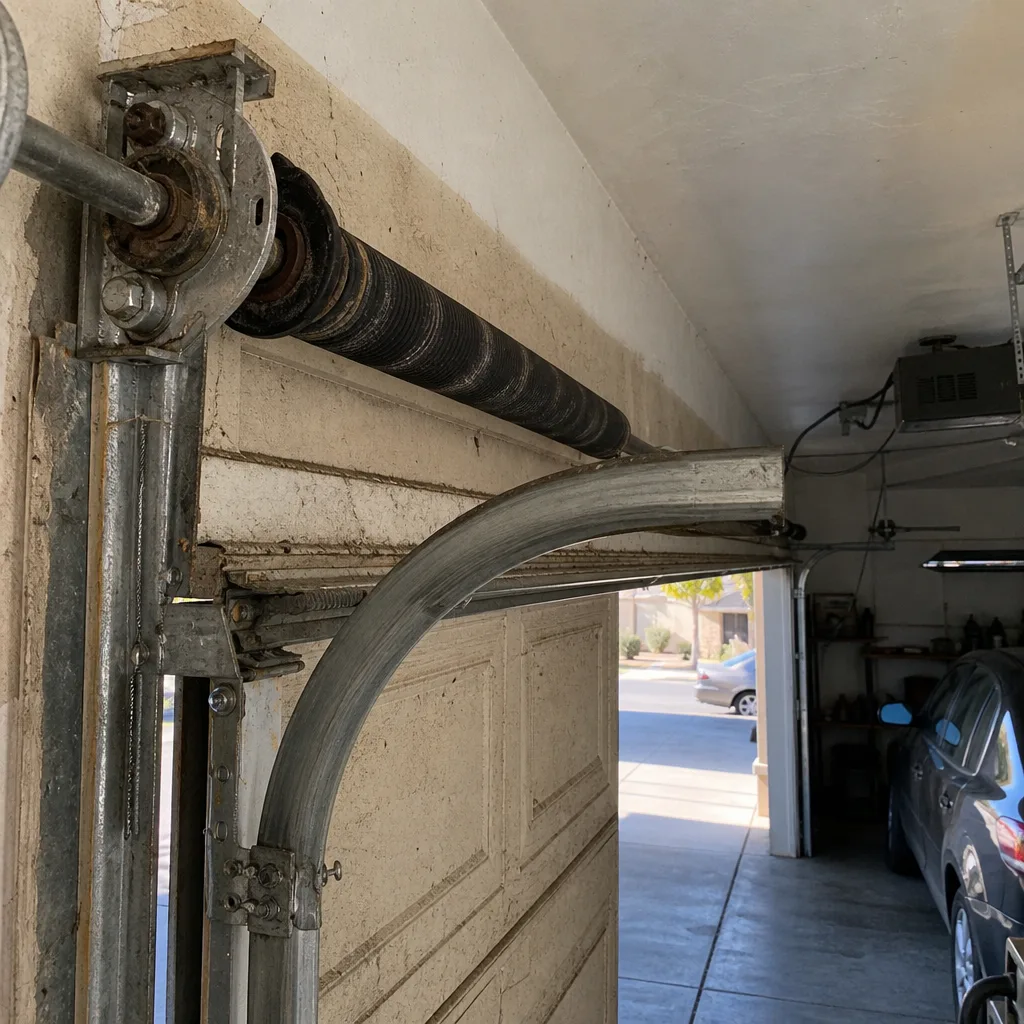 Before
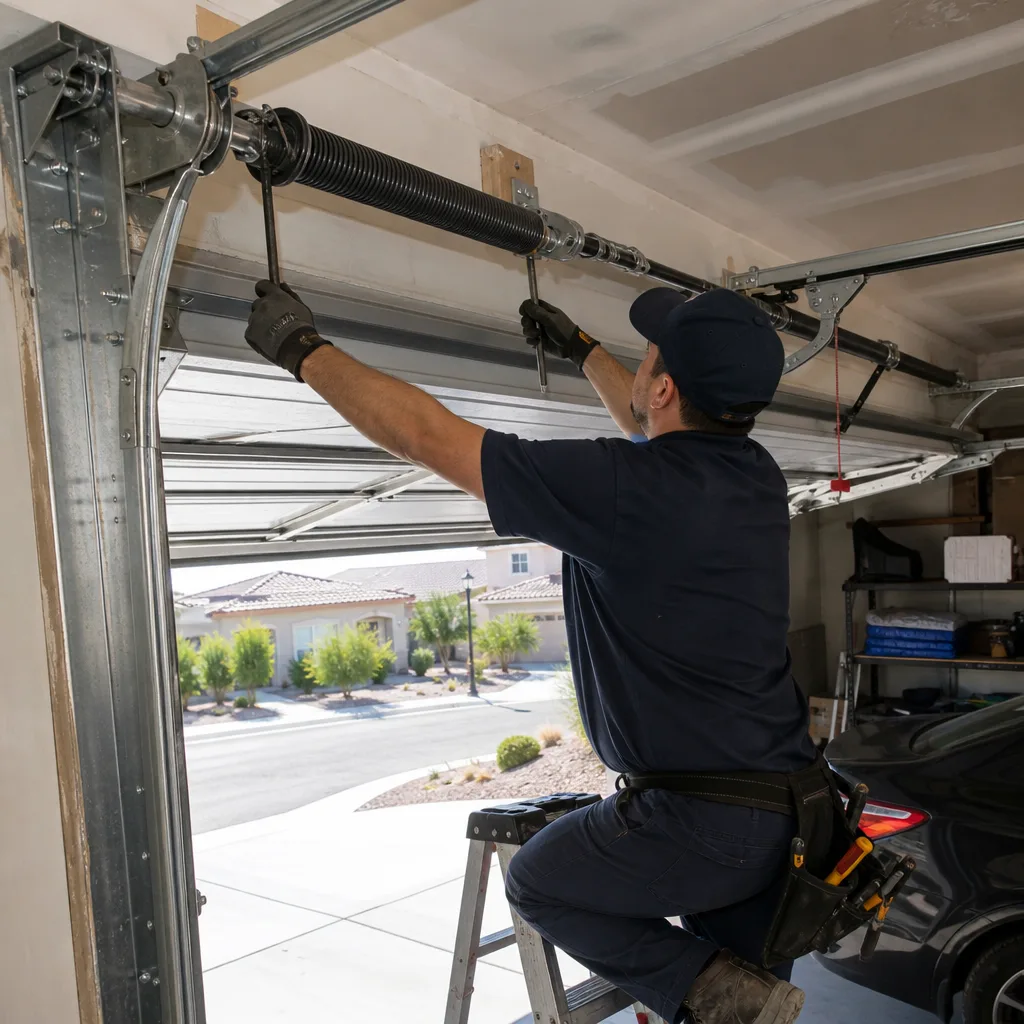 After
After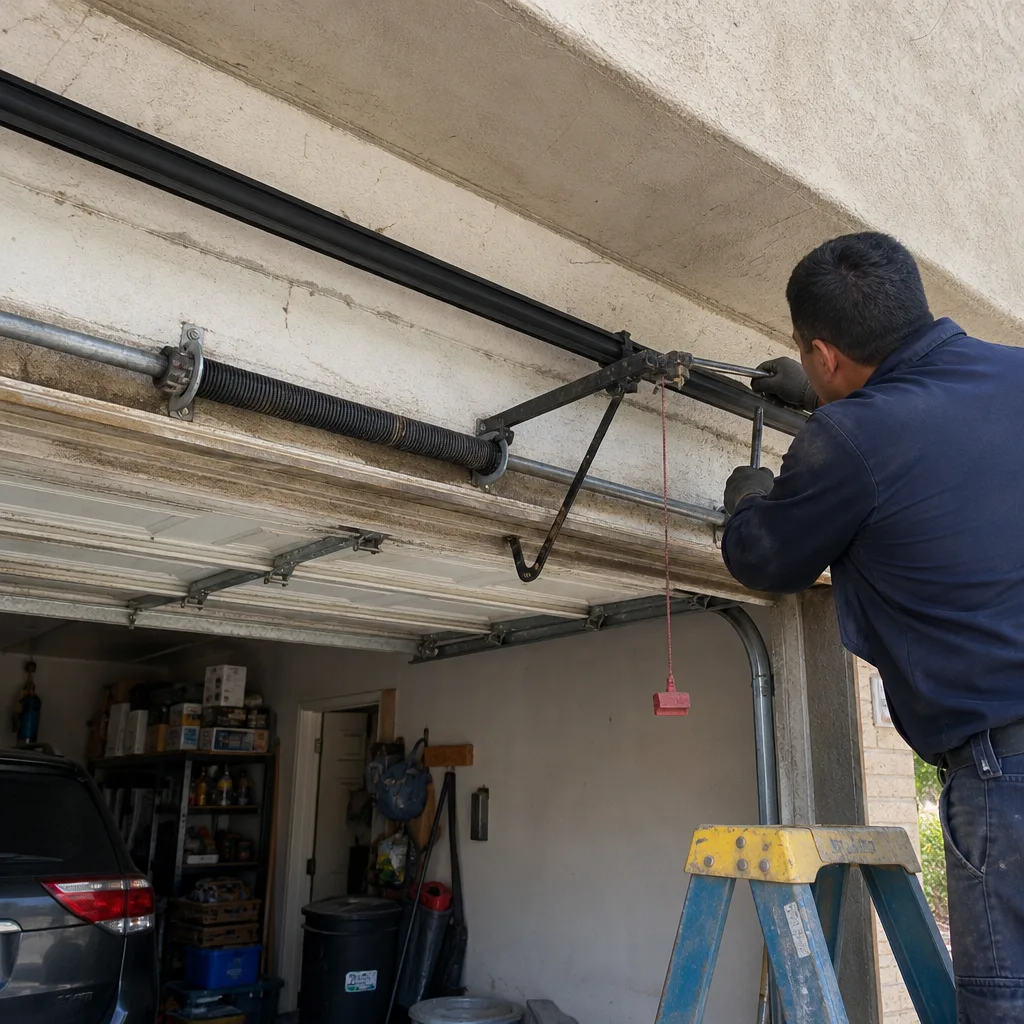 Before
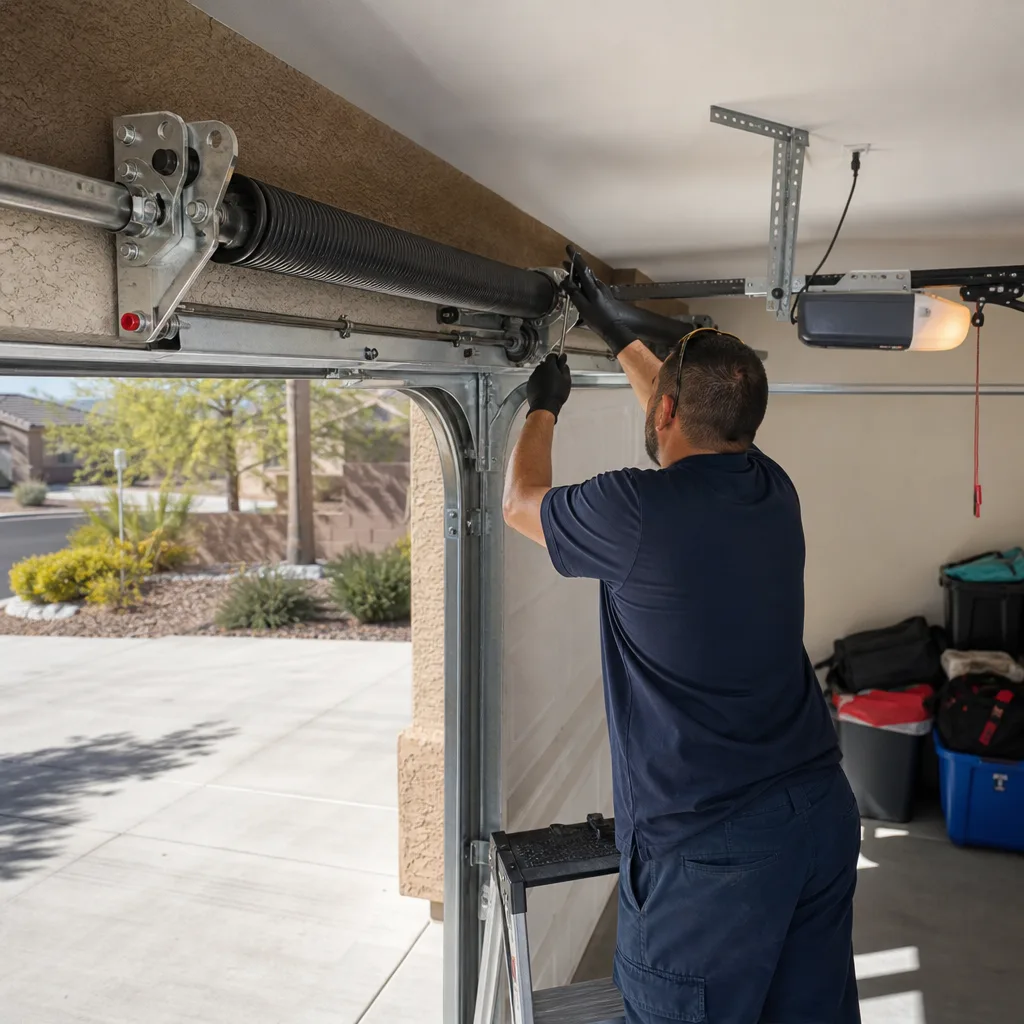 After
After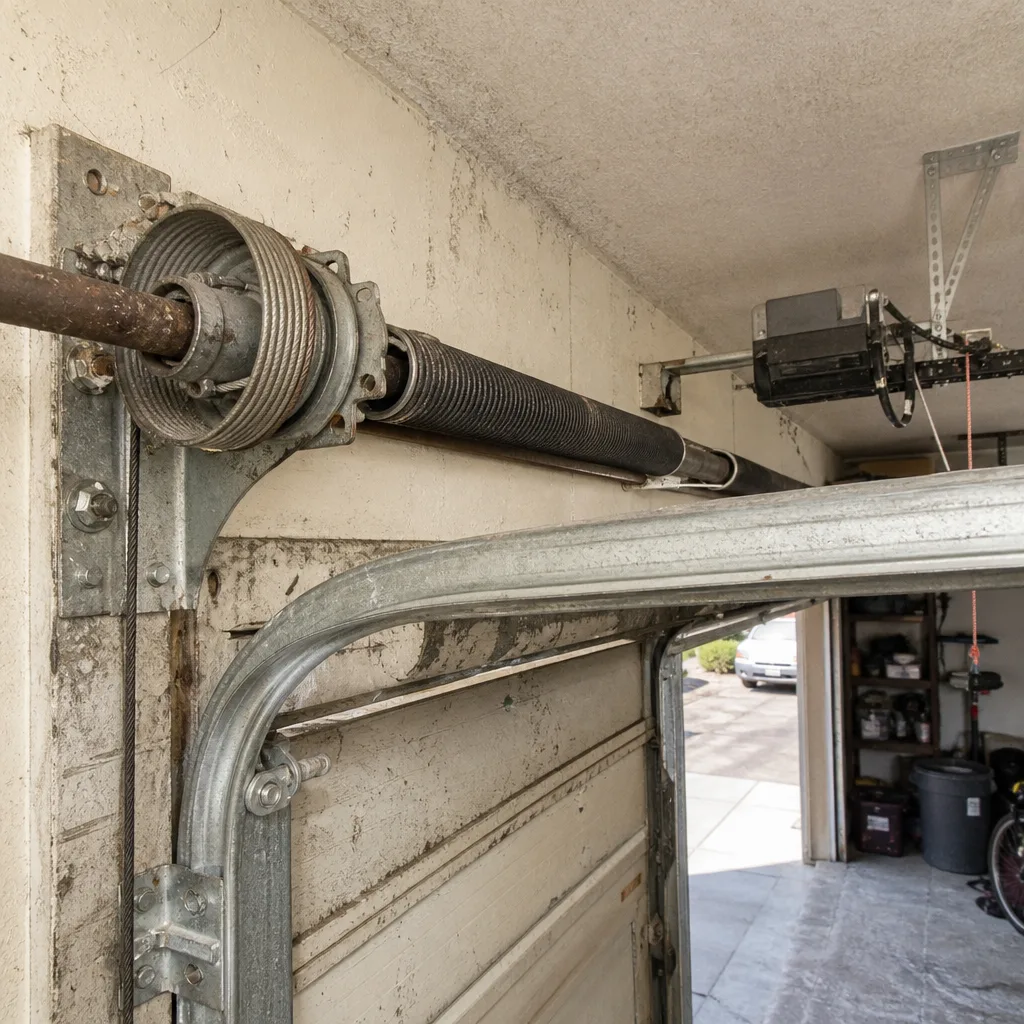 Before
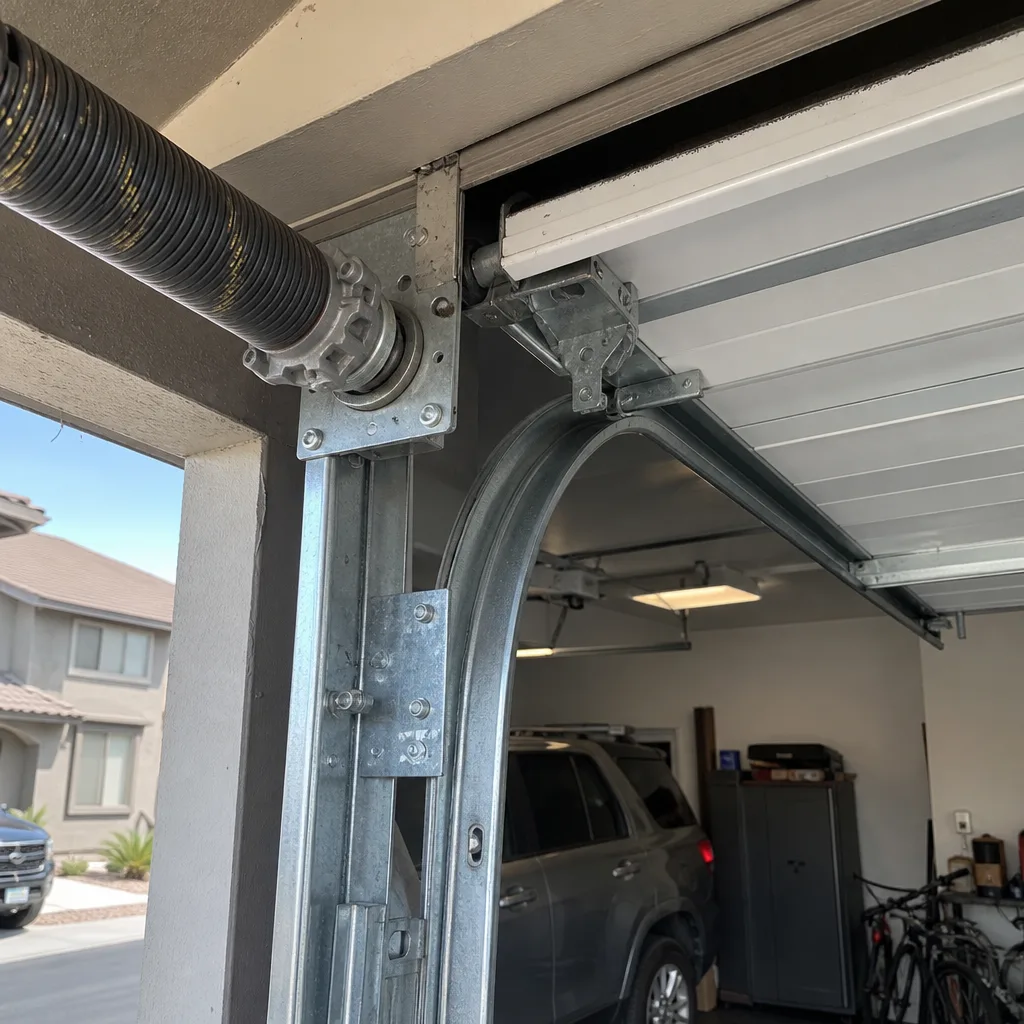 After
AfterWhen to Call a Professional
Some seasonal maintenance tasks are homeowner-appropriate: wiping the sensor lenses, lubricating the moving parts, checking the weatherstripping, running the balance test. Others are not. If the balance test fails, the torsion spring needs adjustment or replacement, and that’s professional work. If you see broken strands in a lift cable, do not attempt to repair it yourself; a cable under tension that snaps can cause serious injury, and the replacement requires disassembling the door’s tension system. If the door is visibly misaligned in the track, or the track itself is bent, that’s a structural issue. And if the door makes a grinding noise that doesn’t go away after lubrication, there’s likely bearing or roller damage that needs replacement. For help deciding whether to tackle repairs yourself, see our DIY vs Professional Garage Door: The Las Vegas Homeowner’s Decision Guide.
Bramwell Garage Doors Las Vegas offers free estimates in Las Vegas; call (725) 210-0201 and a live person answers, 24 hours a day. You’ll get a written price before any work starts, and every repair is backed by the 365-Day Done Right Promise: if a covered repair fails within the guarantee period, we come back and fix it at no charge. That commitment is in writing, not just spoken at the door.
Frequently Asked Questions
Twice a year, in October and March. Those are the months when the temperature is moderate enough that the lubricant goes on evenly and stays in place, and when extreme heat or cold hasn’t yet stressed the metal parts. If you only lubricate once a year, do it in October. Call (725) 210-0201 if you’d rather have a professional handle the lubrication as part of a seasonal tune-up; estimates are free.
Most torsion-spring replacements in Las Vegas run $150 – $280, parts and labor included. The exact price depends on the spring size, the door weight, and whether you’re replacing one spring or both. We recommend replacing both springs at the same time, even if only one has snapped, because the other spring has the same number of cycles on it and will fail soon. Call (725) 210-0201 for an exact quote; you’ll get a written price before any work starts.
In most cases, yes. We carry the most common torsion springs, cables, rollers, and other repair parts on the truck, so a typical repair is done in a single visit. We’ll give you a real arrival window when you call, and a live person answers the phone 24 hours a day. Call (725) 210-0201 and we’ll tell you what’s possible for your specific situation.
That’s the classic Las Vegas pattern: the lubricant you applied in spring evaporates or thins out during the summer heat, and by August the metal parts are running dry. The fix is to lubricate in October and March, when the lubricant will stay in place through the following season. If the squeal doesn’t go away after lubrication, the rollers or bearings are worn and need replacement.
No. The price you’re quoted is the price you pay, in writing, before any work starts. If the technician finds additional issues during the repair, they’ll show you what they found and give you a new written price for the additional work before doing it. The number on the invoice matches the number you approved. That’s the Kingswell standard, and it’s not negotiable.
We carry the parts that fail most often in Las Vegas: torsion springs in the most common sizes, lift cables, rollers, hinges, and opener parts. For less common parts, we source them same-day or next-day from local suppliers. A live person answers the phone 24/7, so you’ll know what’s possible before the technician arrives. Call (725) 210-0201 for a same-day assessment.
The Bottom Line
Las Vegas has two seasons that matter for garage doors: a punishing summer that evaporates lubricant and bakes the weatherstripping, and a windy winter that exposes whatever damage summer caused. The homeowner who works on that two-season rhythm, lubricating in October and March, adjusting the weatherstripping in May and November, and doing a full inspection in September, will spend less on repairs and get more years out of the door. The most important single task is lubrication, and the most important single month is October. If you’d rather have a professional handle the seasonal care, Bramwell Garage Doors Las Vegas is a Kingswell company operating in Las Vegas since 2001, and every visit includes a written price before any work starts and a written guarantee on the repair. Call (725) 210-0201 for a free estimate.
Written by Marcus Ellery, Owner at Bramwell Garage Doors Las Vegas, serving Las Vegas since 2001.